Mapping the Now
A contemporary reflection on listening, attention, and our ability to perceive the subtle and invisible dimensions of the living world.
Presentation
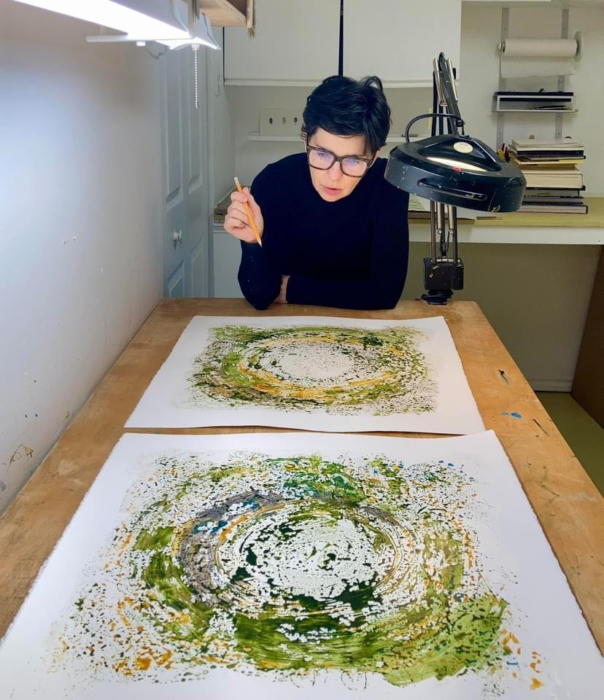
With Mapping the Now Carmelle Pilon invites viewers to perceive the invisible rhythms that run through living things and the landscape. Her paintings—cartographic fragments viewed from above—superimpose organic materials and technological structures to reveal landscapes that are at once real, symbolic, and evocative.
Her approach is rooted in the careful observation of areas where nature and human systems coexist. The electronic circuits integrated into the works—sourced from devices designed for listening to music—become traces imbued with a silent sonic memory. This materiality suggests that forests, territories, and living beings vibrate at their own frequencies—often imperceptible—echoing the Schumann resonance—the Earth’s electromagnetic frequency—envisioned here as a subtle, poetic rather than scientific, background image.
The fragmentation of the compositions and the layering of materials create a contemplative space, where each work—presented in a showcase—contains a fragment of the world that is both fragile and resilient. The exhibition offers a sensory and reflective experience, inviting us to question the way we inhabit the land.
Conceived as a modular whole, Mapping the Now adapts to different contexts and fosters an intimate and sensitive encounter between the artwork, the space, and the audience.
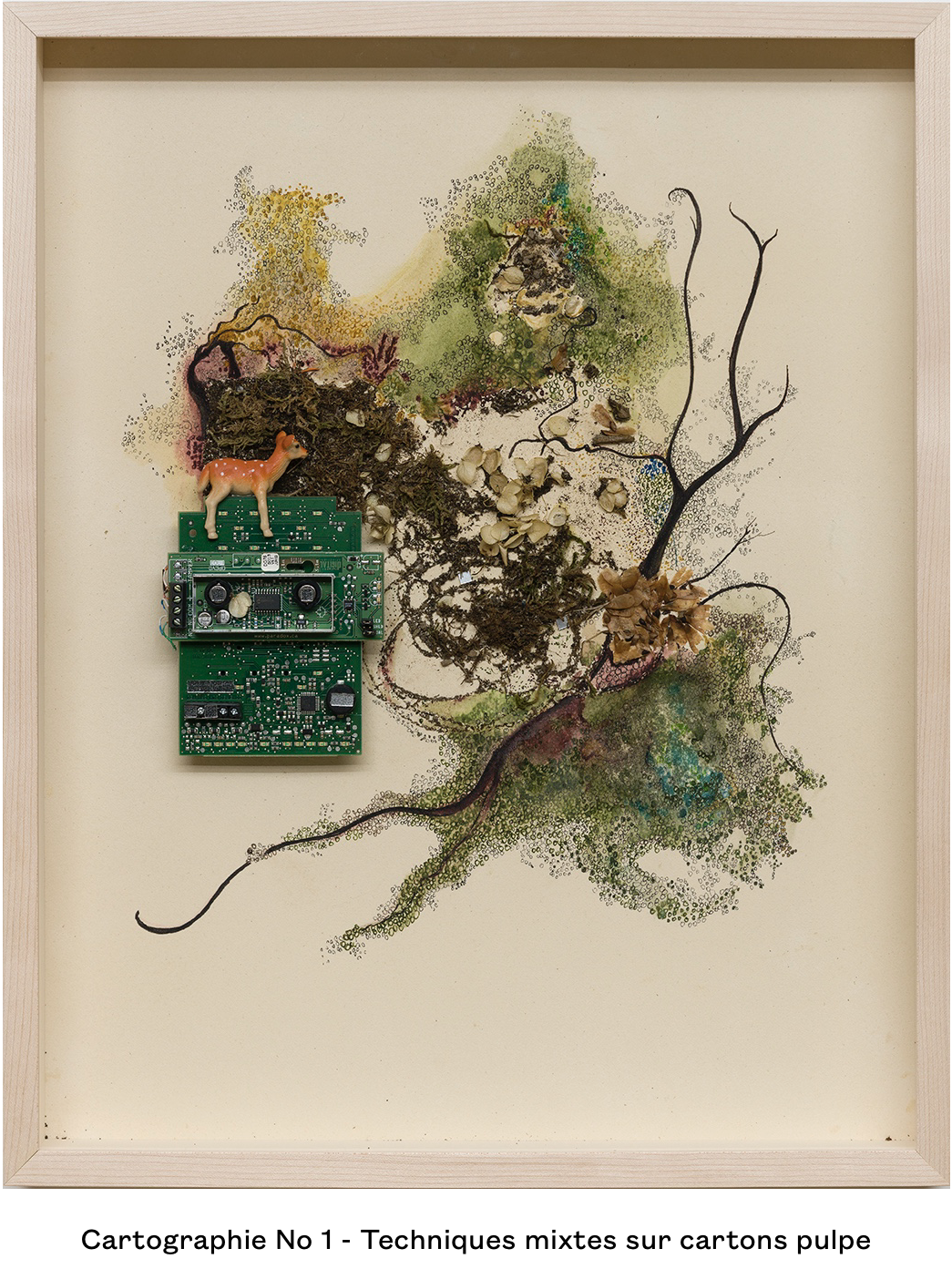
Cartographie No 1
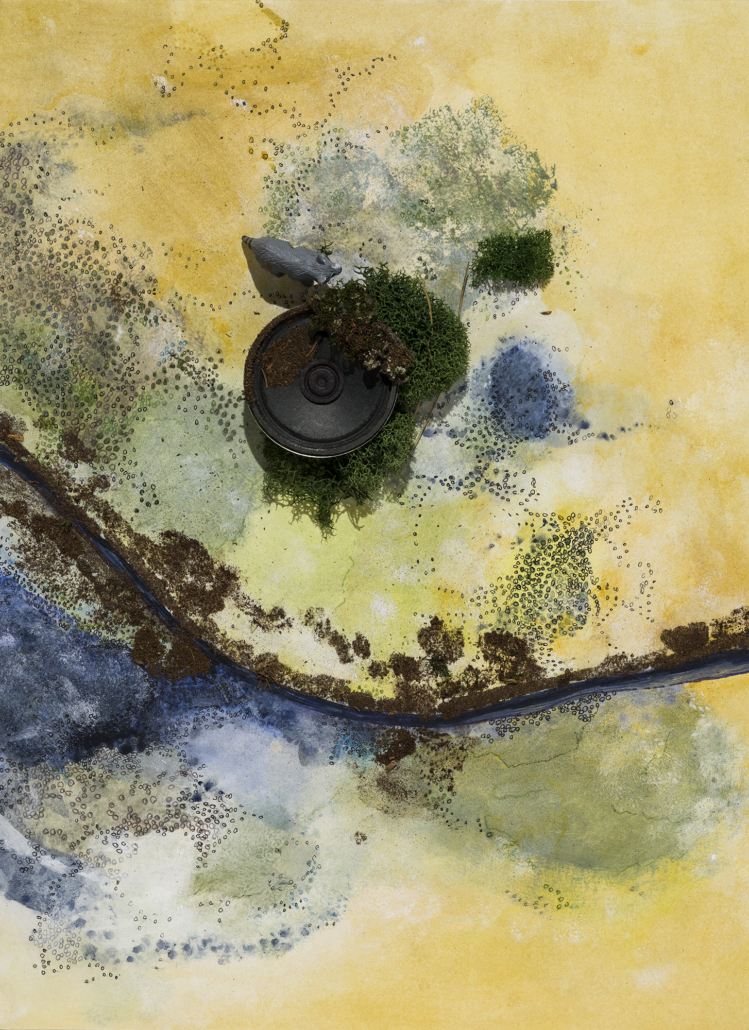
This work draws inspiration from the forest and the woodland caribou, an endangered species that also holds deep cultural significance for many Indigenous nations in Canada and is closely linked to the preservation of territories and living things.
Created using mixed media, it combines electronic circuits with natural materials—moss, dried plants, petals, and soil—to create a dense, tactile surface. The technological components are arranged at the center of the composition and partially covered by organic matter, creating a fragmented landscape.
Topped by a deer figurine, the printed circuits serve as a focal point and introduce an animal presence at the heart of this hybrid topography. The entire piece is contained within a deep frame, designed like a jewel box, which isolates this fragment and highlights its precious nature.
Media and Processes
Support – Paper or pulpboard on particleboard.
Paint and pigments – Acrylic, fluid inks, pigments.
Natural elements – Preserved foam, twigs, foam board, plant fibers, soil, gold leaf to represent vegetation and terrain.
Hand-painted miniature animal figurines.
Electronic components – Electronic parts and speakers from music-playing devices.
Mixed media – A combination of drawing, painting, collage of natural elements, and electronic integration.
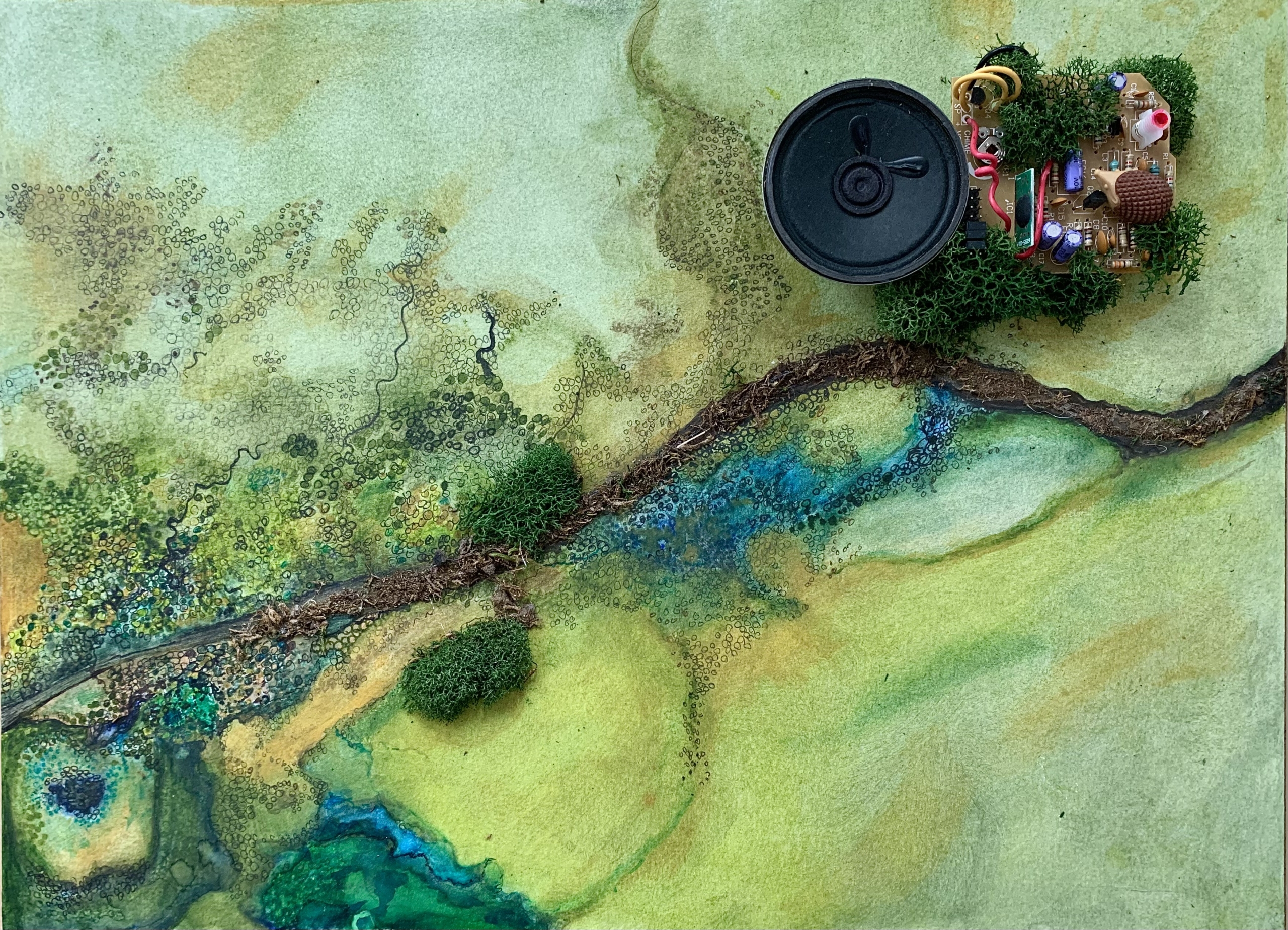
Technique mixte sur papier – 28 x 38 cm
Installation
Mapping the Present » is a modular exhibition designed to adapt to diverse presentation venues. It brings together ten three-dimensional wall reliefs installed at eye level and grouped to create a unified reading that evokes an aerial view of the landscape. A series of screen prints completes the installation. Dedicated to the nocturnal forest, they offer an immersion into contemplative landscapes where living elements reveal themselves through the interplay of shadow, light, and contrast.
The layout favors unobstructed walls and fluid visitor movement, allowing for close observation of the artworks. Soft directional lighting is recommended to highlight the reliefs, textures, and overlapping layers of materials. An accompanying soundtrack can be broadcast in the gallery space or accessed by the public via a QR code. Depending on the venue, light mediation tools (wall text, labels, QR codes) may also accompany the presentation.
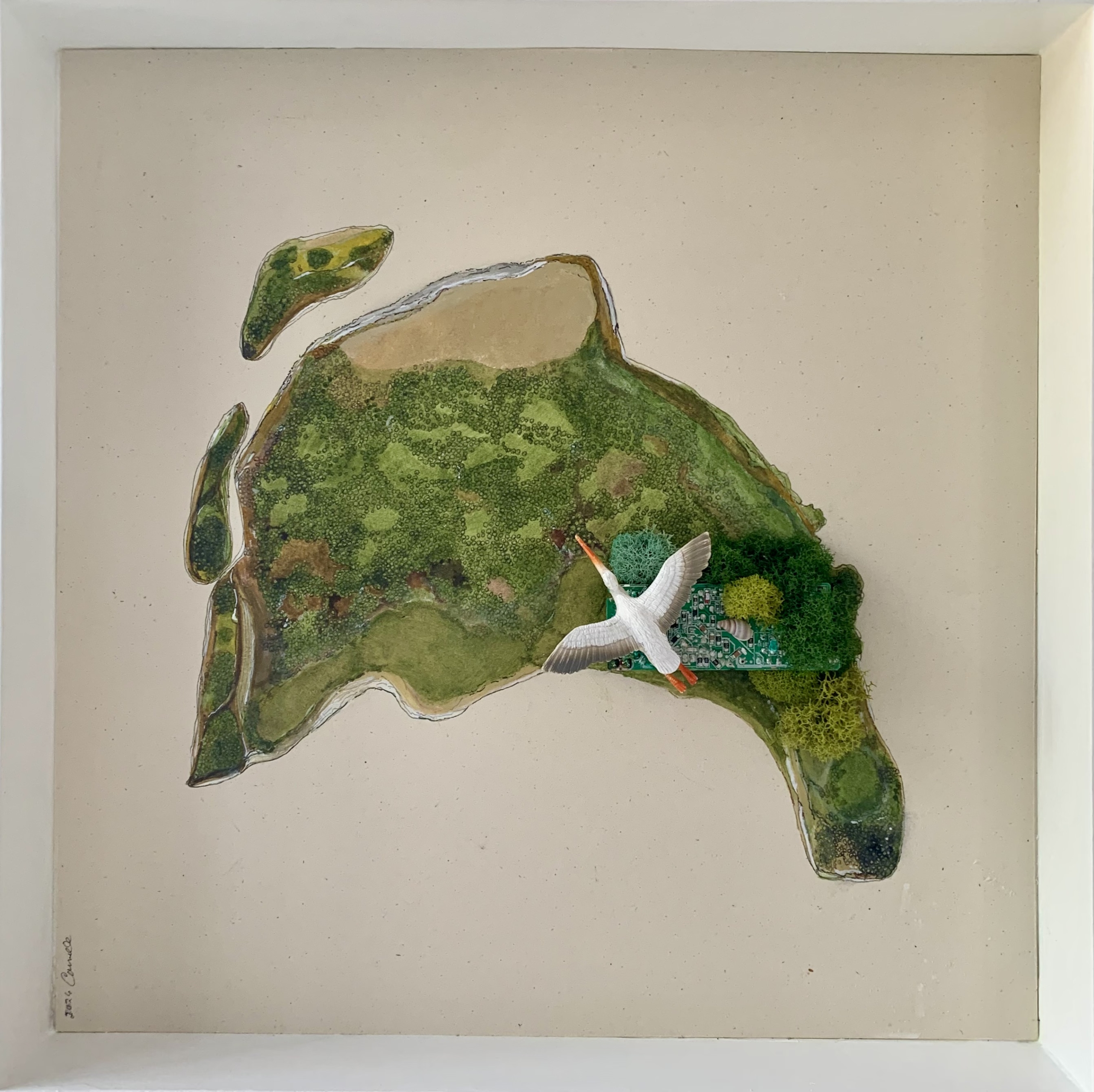
Insula
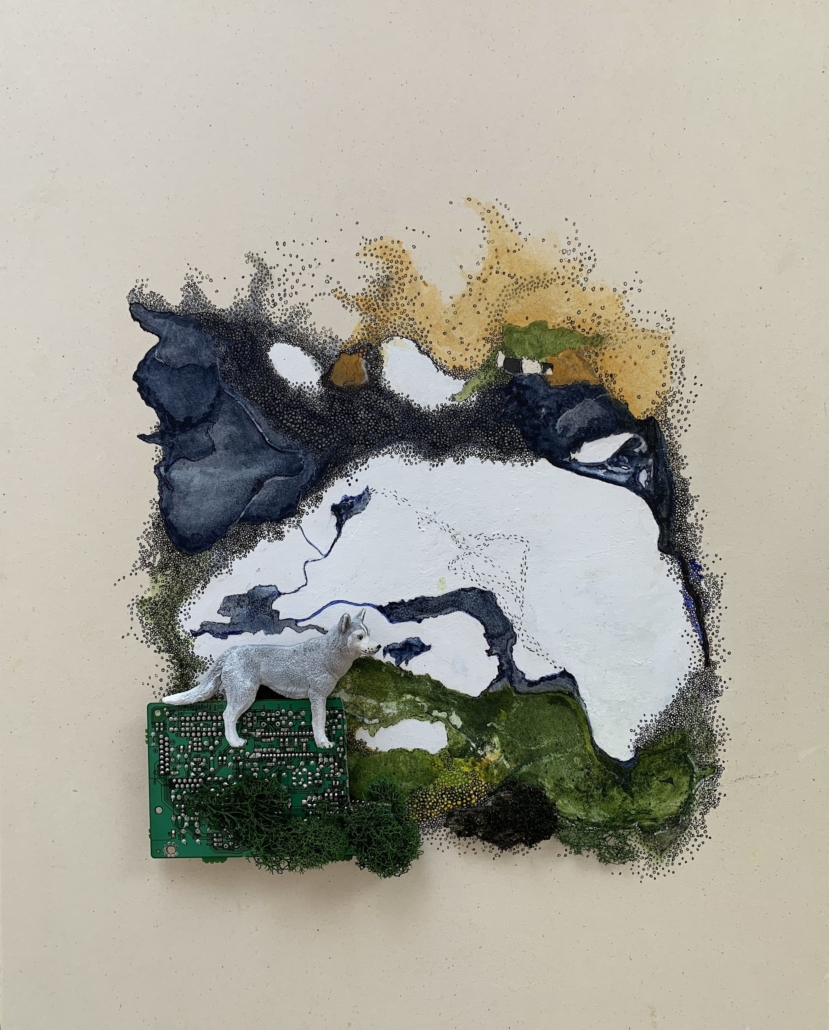
he eleventh artwork, INSULA, explores the intimate geography of resilience. In neuroscience, the insula is an inner land—the seat of self-awareness and the bridge between body and emotion. It is an island refuge where nature reclaims its rights over the remnants of our technologies. A circuit fragment from a musical device is integrated as a root: it symbolizes neuroplasticity and the healing power of music, a true wiring of the soul that rebuilds what has been fractured. Soaring over this hybrid landscape, the stork embodies migratory movement: a flight toward renewal and the promise of a fresh beginning.
Silent Presence
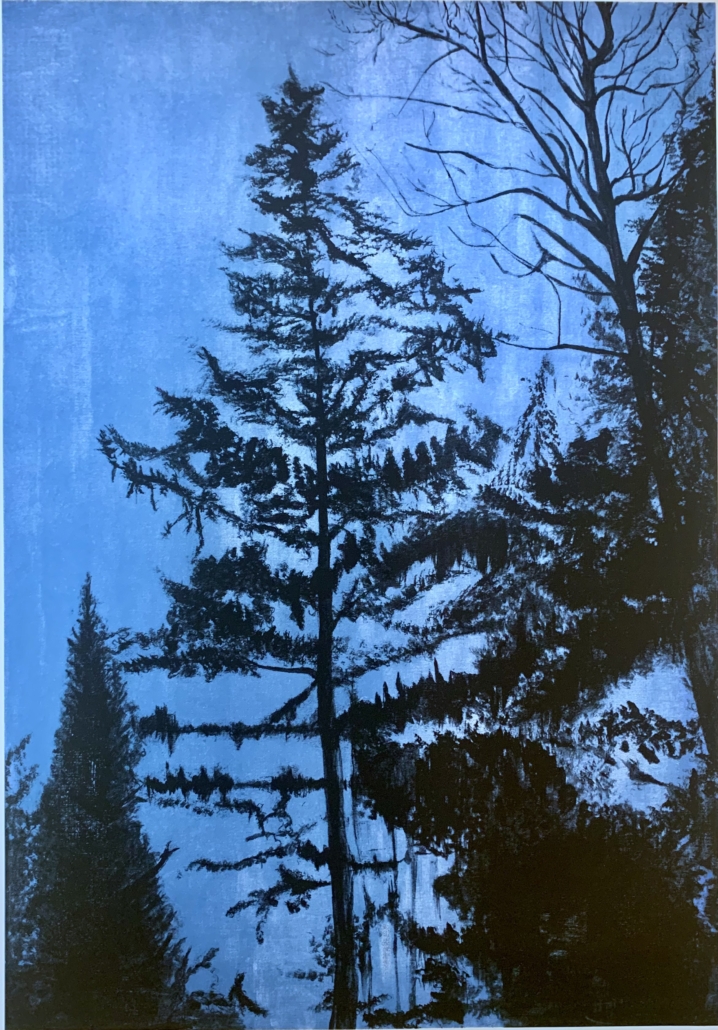
While the artworks in this corpus approach the territory through a cartographic lens, where forests appear from an aerial perspective, this image proposes a shift in viewpoint. It invites us to leave the map behind and step directly into the land. Where cartography observes from a distance, this artwork places us at its very heart. The tree emerging at the center of the composition becomes an anchor, a presence from which the landscape builds and unfolds.
This transition from an overview to an immersive experience deepens the core questions of « Mapping the Present »: how do we inhabit silent places? What landscapes do we continue to carry within ourselves? The screen print does not represent the map; rather, it constitutes one of its possible extensions—a way of moving from a territory observed to a territory lived.
The Silence
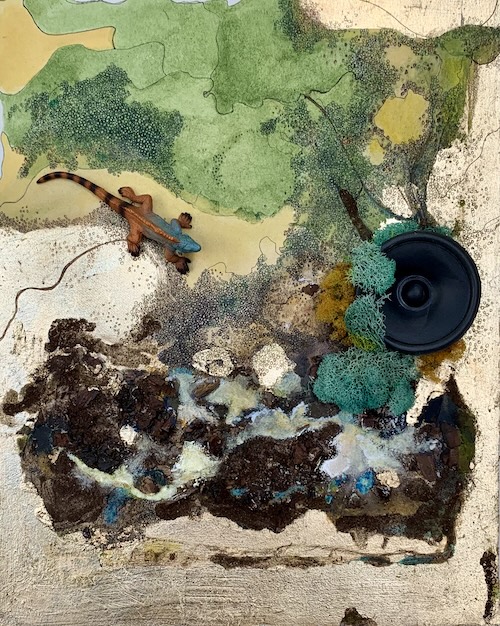
This three-dimensional relief evokes a territory where natural borders are redrawn by economic and geopolitical interests. Inspired by the geopolitical tensions crystallizing around strategic straits in the Middle East, the artwork bridges the living world with the resource exploitation upon which a portion of the global economy depends. The speaker, salvaged from a musical audio device, recalls the absence of song—as if living nature had been forced into silence. Where nature once carried its own resonances, the din of conflict seems to have suspended every voice. Nearby, mosses, lichens, and a lizard recall the fragility of ecosystems that have fallen silent.
Dark materials, resembling an oil slick, cut through the composition like a cartography of black gold. They suggest that beneath the visible lines of maps run other networks—energy, economic, and military—that actively shape our present. In this geography where the living world intersects with coveted resources, the landscape becomes the narrative of an ever-threatened balance.
Médiation
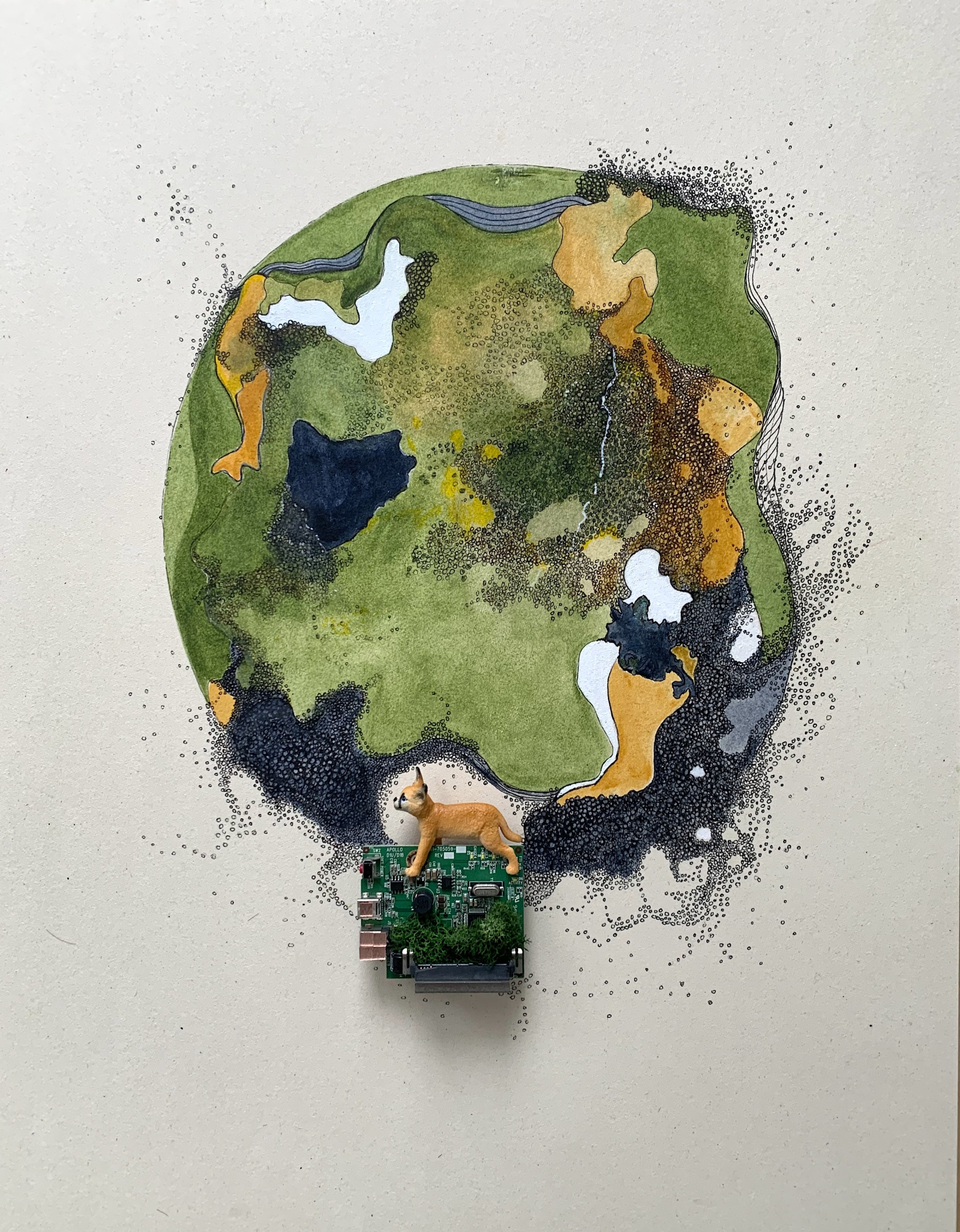
No 8 _ Cette cartographie imaginaire évoque une forêt dont les chants se propagent bien au-delà de ses frontières. Les milliers de points suggèrent les vibrations invisibles du vivant qui se diffusent dans l’espace, tandis que le lynx, figure discrète et attentive, incarne l’esprit de la forêt et veille sur cet équilibre fragile.
L’exposition peut être accompagnée d’activités de médiation favorisant une approche fondée sur l’observation, l’écoute et l’échange.
Rencontre avec l’artiste
Une discussion autour du processus de création, du choix des matériaux et des liens entre territoire, vivant et technologie.
Visite commentée
Un parcours guidé invitant à observer les œuvres à travers leurs matières, leurs strates et leur point de vue aérien, tout en laissant place à une expérience personnelle.
Dispositif d’écoute (optionnel)
Une sélection musicale ayant accompagné la création est accessible par code QR, comme prolongement facultatif de l’expérience de visite.
Équipe de soutien
| Coordination | Carmelle Pilon |
| Préparation de pièces électroniques | Émile Pilon |
| Collaboratrice sérigraphie | Dominique Desbiens, Atelier circulaire |
| Photographes | Guy L’Heureux, Carmelle Pilon |
| Encadreur | Encadrement tout autour |
| Promotion et mise en marché | Phillipe Leblanc |
| Agent | Éric Devlin |
Carmelle
Carmelle Pilon lives and works in Tiohtiá:ke (Montreal). Her multifaceted practice includes painting, drawing, printmaking, and mixed media. She explores the relationships between nature, humanity, and the transformation of the land, guided by the conviction that the invisible shapes our lives just as much as the visible.
Her works reveal layers of textures, rhythms, and structures, where observation, memory, and intuition intertwine. Alongside experimentation and intuitive gesture, research fuels her creative process: she draws on scientific, poetic, and artistic sources to nourish her reflections and her artistic practice.
Influenced by her background in music, Carmelle transposes into her compositions the vibrations, harmonics, and rhythms that permeate living beings and the landscape. Her works invite the viewer to perceive the invisible behind the visible and to sense the subtle flows that connect humans, nature, and technology, offering a space where